Return to reality
Exarlier this year I quit my job to finish my Appalachian Trail hike, which I’m happy to say was successful and will soon prompt a post and book of its own! That’s the more hopeful part of this post…
It does seem like the world dramatically changed while I was away. I know this sounds trite, but it seems true: when I left, the world was dipping its toes into the world of AI, and now it’s is now fully submerged and baptized and trying to push things as far as they’ll go. And you better jump on the bandwagon or else you’ll be left behind…
Or at least that’s how it appears. How it’s being sold.
Everyday life, but different
LinkedIn is maybe one of the worst offenders - before it was already a sort of performative social network preaching hustle culture, and now it’s a new echochamber of AI praise. People with AI headshots, heavily AI-written blog posts with AI images, in some cases bizarre images with anthropomorphisms of their various AI agent personalities. It’s really hard to see the real human behind this world of illusion.
That seems to be the common theme here: it’s harder to spot where the human ends and where the AI begins. Or more generally: where the world of illusion begins. And since it’s still somewhat frontier territory without hardly any checks and balances, folks are profiting from a sham: from passing off AI-created things as human-created.
It’s not just LinkedIn unfortunately. I’m starting to receive AI pull requests for my open source libraries on Github. I’m torn - I appreciate folks using my code and trying to make it better, but I feel like I’d value it more if I knew it was coming entirely from a human. Is there even a human behind the pull request? There’s no guarantee. Did a human actually review the code? Now I’m not so sure.
Facebook is now pushing photo restoration groups to me where the vast majority of members feed blurry family photos into the AI machine, which inevitably replaces important features - faces, poses, clothes, colors. It’s way beyond Photoshop - it’s as if someone cut faces from other photos and pasted them over. The output is undeniably a sharper photo, but with features essentially coming out of the human meat grinder of AI training materials.
The input: a blurry family photo that captured reality.
The output: a sharp image with someone else’s family pasted in - a simulcrum of something that never happened, like someone’s confused and demented memories. What’s scarier is that many folks commenting on the “restored” photos seem thrilled or at least satisfied at the output, with blatant disregard for the truth.
Reddit has also been affected. For a while there, it was a great alternative to search engines like Google which had degraded out of useful existence. But marketers unfortunately discovered reddit and heavily leaned in to guerilla marketing, hiding behind the guise of a human beings organically recommending products (side note: I briefly worked for a company that used these tactics, and I’m not sure if they ever revealed the truth to the other users; reddit users thought they were interacting with real people, and the marketers were thrilled).
And now the same is surely happening but now at scale, with AI bots. It’s the general trick being pulled on us all now: something in human form, like ourselves, which we pay more attention to and value more. If it’s revealed to be AI its value degrades, so that’s hidden from the marketing.
Fake author, fake reviews
This plague is also spreading into my beloved world of books. I recently purchased a secondhand travel guide for Japan that took me longer than I’d like to admit to find it was written by AI. It became clear when I realized the book was organized in a strange unfamiliar way - somewhat hard to pinpoint, but just the feeling that no human being would intentionally structure something this way.
Part of what eventually tipped me off were the over-the-top stories that are too ridiculous to believe, crafted with the bait of an eager foreign audience eager to eat up anything supposedly uniquely Japanese:
An introduction: The Bamboo and the Microchip
The first time my American mother tried to throw away a perfectly good chopstick wrapper, my father nearly had a heart attack.
“Mottainai!” he exclaimed, snatching it from her hand. With meticulous care, he folded the paper into an origami crane, placed it beside his plate, and continued eating as if nothing unusual had happened.
My mother looked at me, bewildered. I shrugged, caught between worlds as usual.
That evening, I found the paper crane perched on my pillow. When I asked my father about it the next morning, he simply said, “Yesterday’s wrapper, today’s art, tomorrow’s memory.” Then he winked and returned to his newspaper.
Growing up half-Japanese in Kyoto during the technology boom of the 1980s, these small cultural collisions were my daily bread. My American mother valued efficiency and practicality; my Japanese father saw poetry in mundane objects and ritual in everyday actions. Their marriage was itself a dance between different worlds — much like Japan itself.
Mottainai (勿体無い, “waste not, want not”), is a real thing, but this incident is a straight up caricature out of a cartoon. The baffling thing is that other parts of the book are full of bits and pieces that are useful and sometimes obscure, and seemed at first glance to be true. And there’s a reason for that: the AI model was trained on real human output, real useful tidbits, and then combined into the big AI meat grinder and given a human face to make it easier for humans like me to accept.
I looked up the book and the author on Amazon and of course, like everything on else on Amazon the book has 4.5 stars, with many likely bot reviews. The author himself - surprise - turned out to be a work of AI, with a presence only on Amazon, with an accompanying AI generated photo. With skin with that characteristic Krispy Kreme glaze, and a biography that seems a little too uncanny at being a sort of cultural liason:
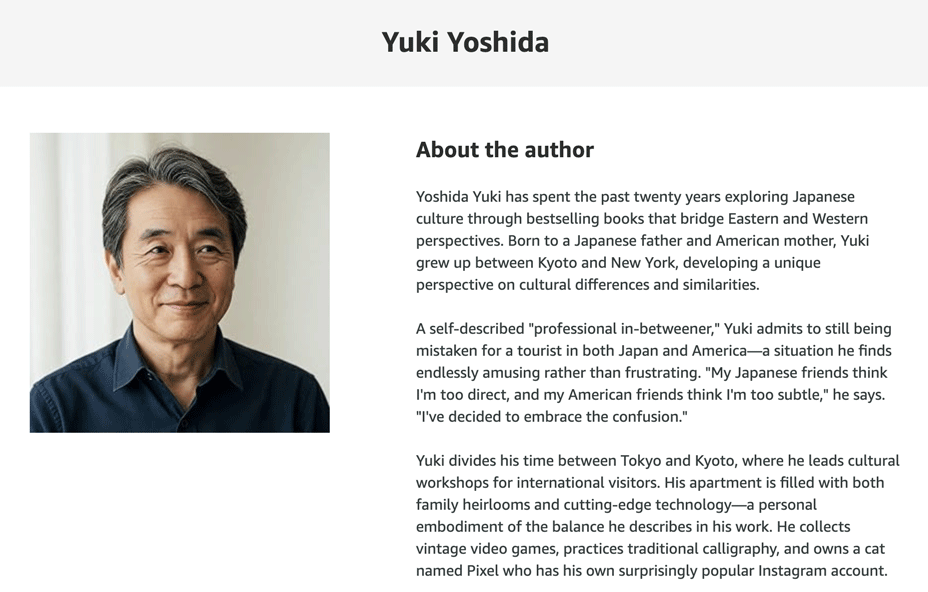
There’s no text or flag anywhere to tell us humans that this is a fictional author persona. Don’t you think we humans have the right to know?
The only path currently is for more expert-level users to run this through checks such as SynthID Detector, which I did, and which indeed validates my hunch: “SynthID was detected. This media was made or edited with Google AI”
And why pose as a fake human and not disclose it? Because there is as of yet no requirement to disclose it as such. And it’s very likely it would result in lost sales, because people know AI has a tendency to produce low or, by a limitation of its own nature, only average quality works. So we now find ourselves in an era where Amazon is knowingly hawking junk created by bots masquerading as humans, which in turn are reviewed by other bots disguised as humans.
The same thing is happening on YouTube - without disclosure, a super realistic AI avatar with convincing features passes off life advice or whatnot. One is a minimalist YouTuber with a strangely familiar backstory: growing up in Japan until they were 12, then moving to America. And now becoming a perfect cultural go-between, as a YouTuber and… surprise, self-published Amazon author. This should sound familiar to you.
I hate to admit that the videos tricked me. I remember my brain shutting down small red flags that didn’t seem quite right: why didn’t he have a Japanese accent? Ok, maybe he was young enough to adopt an American accent. Then there was a childhood photo that looked nothing like him. Ok, maybe his face just changed a lot when he grew up. For some reason I wanted to give him the benefit of the doubt.
There were more signs. The books on the shelf behind him with garbled words, or other visual slipups spotted by other viewers, like a futon cover that slightly defies the laws of gravity as it’s being put away into the cupboard. Or huge mispronunciations that no one with his background would get wrong.
Here we encounter our old friend mottainai, that trendy Japanese word, horribly butchered, because he’s a robot:
Mohkt’teen’yeah: ah yes, that famous proverb all Klingons live by. The pronunciation should actually be something like “moe-tie-nigh”. It would have gotten it right if it was a human with the real, lived experience that it claims to have. But it’s AI, and it doesn’t have that. All it has in its AI training data is the meat grinder of secondhand lived experiences.
It’s a shame really, because I really enjoy reading direct firsthand experiences of people who have lived, and AI creates an extra distance from that. I enjoy reading things by Kierkegaard and Marcus Aurelius, people who have lived long ago and also experienced similar challenges of the human condition. These books end up being almost like an old friend - the closest you can get with communing with them as a fellow human. AI will only create more distance from these sorts of cultural artifacts - putting them through the AI meat grinder, and coming through as a weird mystery meat. The simulacrum of a lived experience.
Why it feels wrong
I think AI can still be useful. It’s hard to argue against that. At a minimum it’s probably healthy just to think of it as an extra tool that got added to Photoshop. Used minimally it could be helpful and might save time, just like the clone stamp tool or whatnot. Like everything, best in moderation, so say both Aristotle and Confucius (孔子). A tool to cut out the more mundane things, to brute force solutions where it would otherwise be a monumental waste of time for an individual human. A tool to spot tumors in X-rays where otherwise it would go unspotted.
But to use it for untruth, for deception, and for human replacement or human imitation like above, is goes beyond what should be allowed.
Manifesto: 3 Rules We Need For AI
AI can undeniably be useful, but it can also obviously be used to deceive. And it is being used to deceive. Can we get some ground rules here please?
I propose a simple manifesto:
- Give me an AI content flag, and show it prominently. If I am not buying from or spending time with a “who”, but a “what”, I have the right to know.
- Avoid human imitation. Hyper-realistic “author” AI photos and videos should either be banned completely or shown with an even more prominent flag.
- How much AI was used? Tell me. It’s on a spectrum from “used in the same capacity as a spell checker” to “ideated and entirely written by AI”, and I have a right to know.
Comments